
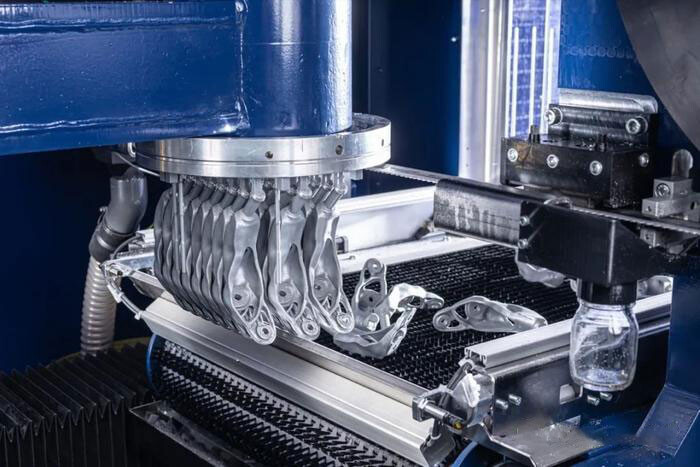
On May 30, 2024, as a 3D steel printer printed the first steel component on the International Space Station, steel entered the space age.
At the end of May 2024, in the International Space Station, the 3D metal printer of the European Space Agency's (hereinafter referred to as "ESA") Columbus experimental module completely changed the way of on-orbit manufacturing. In a world first, the printer used liquid stainless steel to print a small S-shaped curve, proving that 3D steel additive manufacturing - a process that builds objects one layer at a time - can be achieved in space.
"This S-shaped curve is a test line, marking the successful end of the debugging work of our 3D metal printer." ESA technical officer Rob Postema explained. “With the success of the first print and the introduction of additional reference lines, we will soon be printing complete parts.”
Polymer-based 3D printers have been printing plastic objects on the International Space Station for some time, but metal printing is more difficult because it requires higher temperatures and lasers to melt the metal. When using a 3D steel printer, a stainless steel wire is first fed into the printing area and then heated by a high-power laser, which is approximately 1 million times more powerful than a standard laser pointer. As the stainless steel wire melts, the stainless steel is printed into the desired shape.
ESA plans to use 3D stainless steel printers to help create a circular economy in space. In order to extend the life of space equipment and optimize resources, ESA hopes that once the 3D stainless steel printer is fully operational, it can be used to print parts and tools needed in orbit, thus avoiding the need to transport these parts and tools from Earth by rocket.
"3D metal printing in space has a promising capability that can not only support future exploration activities, but also further promote the sustainability of space activities through a wide range of applications such as on-site manufacturing, repair, and recycling of space structures. Including The fabrication and assembly of large-scale infrastructure in orbit, as well as plans for long-term human settlement of planets, are key focuses of ESA’s upcoming technology cross-cutting projects,” said Tommaso Ghidini, Head of ESA’s Mechanical Division.
I sincerely hope that the pioneers in the steel industry can also see the progress that steel has made in both a substantial and symbolic sense!
Related Posts
- ▶ Hyundai Steel, POSCO Start $5.8B Louisiana Steel Plant
- ▶ Vale and ABB Expand AI in Brazil Iron Ore Operations
- ▶ Nucor Steel reported adjusted net income of $1.11 billion in the second quarter.
- ▶ JSW Steel Boosts Output 3% in July on India Growth
- ▶ ArcelorMittal is considering building a second electric arc furnace in Calvert
- ▶ US Probes Stainless Steel Pipe Imports From 3 Countries
- ▶ US Exempts Brazilian Pig Iron From 25% Tariff
- ▶ Regional Billet Prices Fell $5-15/T in June Markets
- ▶ EU Steel Producers Urge Stronger CBAM Rules
- ▶ Global Steel Production Fell 0.3% YoY in May 2026
Online Message


Leave A Message
If you are interested in our products and want to know more details, please leave a message here, we will reply you as soon as we can.